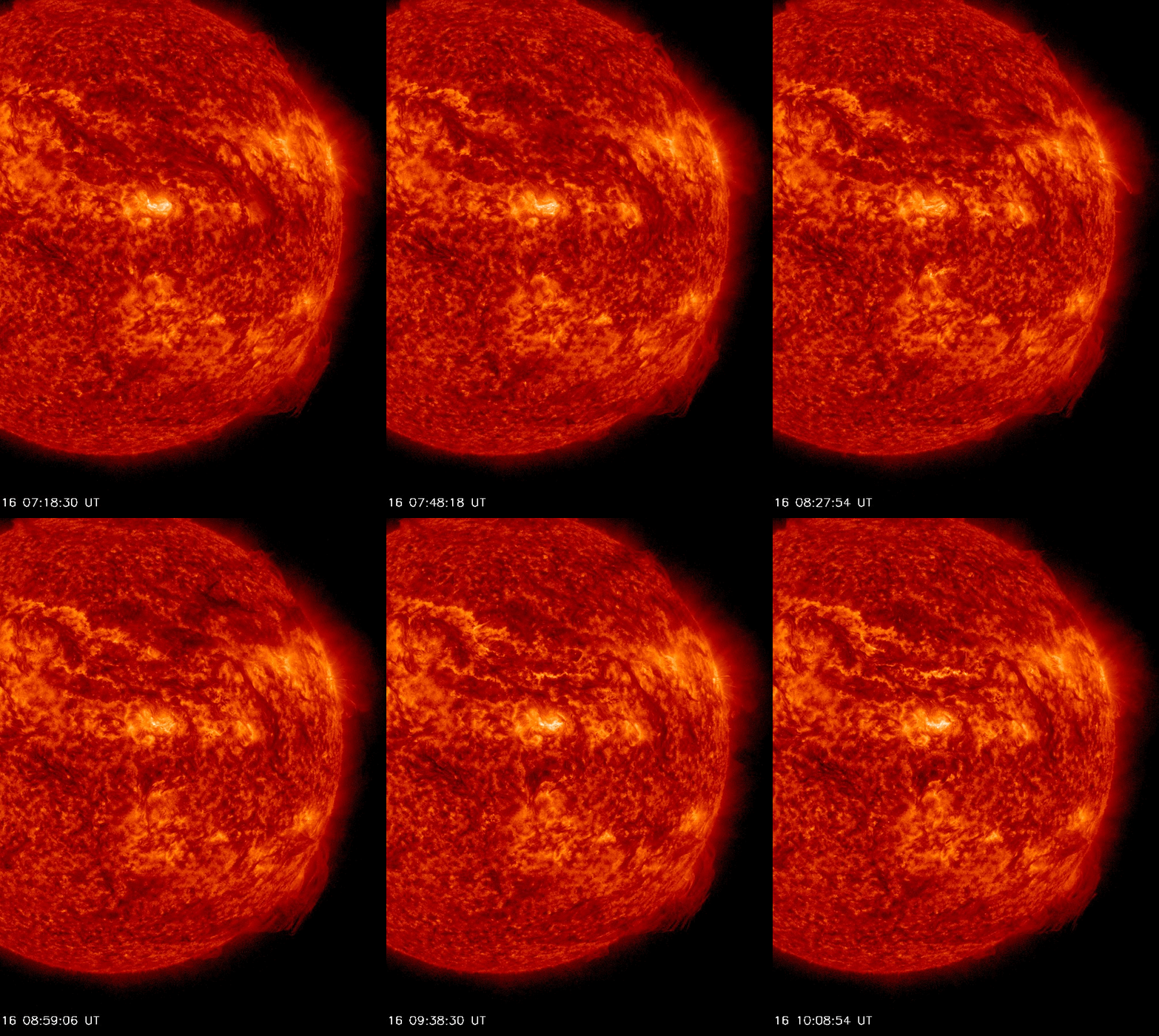
Earth-directed Solar Flares
EARTH-DIRECTED SOLAR FLARES: (September 16, 2023) – Sunspot AR3429 is crackling with M-class solar flares. This interest-compressed movie from Sept. 15th shows extreme ultraviolet flashes from four eruptions, all Earth-directed.
Pulses of radiation from this sunspot are ionizing the top of Earth’s atmosphere, creating a rolling series of shortwave radio blackouts over all longitudes of our planet. Ham radio operators, pilots and mariners may notice occasional loss of signal, especially at frequencies below 20 MHz.
ONE CME JUST HIT EARTH… (September 17, 2023) – As predicted, a CME grazed Earth’s magnetic field on Sept. 17th (0246 UT). First contact did not cause a geomagnetic storm. However, minor G1-class storms could develop in the hours ahead as Earth passes through the CME’s magnetized wake.
AND ANOTHER CME IS COMING: A huge magnetic filament erupted on Sept. 17th, involving almost an entire hemisphere of the sun: movie. The blast hurled a CME directly toward Earth. According to a NASA model, the CME should hit Earth’s magnetic field late on Sept. 19th. The impact could spark G2-class geomagnetic storms with auroras in northern-tier US states from New York to Washington State.
(CME COMING, Cont’d) Pulses of radiation from this sunspot are ionizing the top of Earth’s atmosphere, creating a rolling series of shortwave radio blackouts over all longitudes of our planet. Ham radio operators, pilots and mariners may notice occasional loss of signal, especially at frequencies below 20 MHz.
So far none of the explosions has hurled a CME toward Earth. They’ve all been too brief to lift a CME out of the sun’s atmosphere. However, there is a huge magnetic filament snaking around the sunspot group. If continued flaring destabilizes the filament, it could erupt and hurl significant debris in our direction.
A RUSHED, SURPRISE ROCKET LAUNCH: (September 16, 2023) There was no warning. On Thursday night at 7:28 pm PDT, a Firefly Alpha rocket lifted off from the Vandenberg Space Force Base in California. It carried an unusual satellite named “Victus Nox.” Stephen Hummel saw the launch more than a thousand miles away at the McDonald Observatory in Texas:

Firefly Alpha launch – Taken by Stephen Hummel on September 14, 2023 @ McDonald Observatory, TX
“A bright exhaust cone expanded to cover a large area of the sky during astronomical darkness,” says Hummel. “After the cone faded, there was a slight red afterglow” probably caused by the rocket punching a hole in the ionosphere.
Latin for “conquer the night”, Victus Nox is a US Space Force experiment, testing the ability of Firefly Alpha to launch a military satelite with only 24 hours notice–a so-called “responsive launch.” In the past, typical Defense Department launches took anywhere from two to five years. The last responsive space experiment, the June 13, 2021 launch of TacRL-2, required 21 days.
Alpha Firefly successfully launched Victus Nox only 27 hours after it received a “go” notice. The extra 3 hours was a result of a weather delay. The mini-fridge-sized satellite will now provide “space domain awareness” data to the Space Force.
SPACE.COM NEWS: SEPTEMBER 16, 2023
Are we about to see a rare green comet light up the sky? An expert explains what to expect from Comet Nishimura

Comet Nishimura seen on Aug. 18, 2023 from June Lake, California, while sporting a green coma and a thin tail. (Image credit: NASA/Dan Bartlett)
Of all the objects in the solar system, perhaps the most spectacular are the great comets that occasionally grace our skies. If you’ve been on social media in the past few days, you’ve probably seen articles proclaiming we have such a comet in our skies right now: C/2023 P1 (Nishimura).
As I write this, Comet Nishimura is swinging past on its first visit in more than 400 years. Japanese astronomer Hideo Nishimura discovered the comet on Aug. 12. Soon after, pre-discovery images of the comet dating back to January were found, allowing astronomers to determine its path.
They quickly realized Nishimura would swing closer to the sun than the orbit of Mercury this month. Given the comet’s brightness at the time of discovery, it could become bright enough to see with the naked eye. So, will it be a spectacular sight in our skies? Probably not.
Unfortunately, Nishimura’s path will keep it close to the sun in the sky as observed from Earth. While it’s definitely bright enough to be visible to the naked eye in dark skies, at best it will hug the horizon just after sunset – almost lost in the sun’s glow.
Still, astronomers across the globe are excited. Even a hard-to-spot naked-eye comet is worth observing. And as science writer and astronomer David H. Levy once said: “Comets are like cats: they have tails, and they do precisely what they want.”
ANNULAR SOLAR ECLIPSE (Spaceweather.com, Sept 14, 2023)
GET READY FOR THE ANNULAR SOLAR ECLIPSE: Mark your calendar. On Oct. 14th, the Moon will pass in front of the sun, producing an annular solar eclipse visible from North and South America. In this map, the yellow band shows where the eclipse will be best:

Annular Solar Eclipse: October 14, 2023
This should not be confused with a total eclipse, where the Moon completely covers the sun. During an annular eclipse, the Moon is a little too small for complete coverage–a result of the Moon’s elliptical orbit. When the Moon passes in front of the sun, an annulus remains visible, creating a “ring of fire” in the sky. It is still very cool. Indeed, you will literally feel cool as the diffuse shadow of the Moon passes overhead, dimming the landscape and lowering the air temperature by a few degrees.
The “path of annularity” is about 100 miles wide. Along its centerline, the sun will be ring-shaped for more than 4 minutes, with as much as 95% coverage of the solar disk. Be careful! Even a 5% sliver of the sun can be blindingly bright. Watch the event using ISO-approved eclipse glasses.
Outside the path, observers will see the sun turn into a crescent, fat or thin depending on how far they are from the centerline. This is called a “partial eclipse,” also best seen using eclipse glasses. Almost all of North and South America is in the partial eclipse zone.

Annular Eclipse: The Ring of Fire, Credit & Copyright: Dennis L. Mammana (TWAN); 2009 January 25, NASA Astronomy Picture of the Day
See Paths of Totality (American and Worldwide Maps to 2030), GreatAmericanEclipse.com

Great American Eclipse 🌞🌗🌎 on X, GreatAmericanEclipse
Fly over the 2024 total solar eclipse and 2023 annular solar eclipse
These animations of the Moon’s shadow across North America simulate the view from a spacecraft 125 miles high chasing the shadow! On April 8, 2024, everyone inside the shadow will experience the breathtaking sight of the Sun’s corona during the total solar eclipse. Totality races from Mazatlan to Newfoundland.
THE TRECENA OF DOG/OC: THE DOG’S TREASURE OF UNCONDITIONAL LOVE
MAYAN CALENDAR DAYKEEPER’S JOURNAL
13 Wind/IK (eek), Cherokee Whirlwind/ Agalu’ga, Destiny Kin 182, Position 2
September 17, 2023, 09/17/2023
13 Wind/IK (Cherokee Whirlwind Agalu’ga) – Day13 of 13 of the 1 Dog/OC trecena
Descriptions by Ian Xel Lungold (12 Sun/AHAU), wisdom preserved on MayanMajix.com
Galactic Tone 13: Ascension; Thirteen assists us to go to the next higher step, propels us to try something new or to try again. Thirteen energy takes us over the next mountain just to see what is there. Thirteen carries the last success to the newest effort. Thirteen is a number associated with the Ascended Masters, creation, expansion, and manifestation.
Wind/IK: Breath of spirit, breath of life. Winds embody the power of dissemination and planting of good seeds or ideas. They are dreamers and planners with powerful imaginations. Wind persons make great orators and they spread the word of spiritual inspiration as if carried by the wind. Wind is the power behind the movement of natural cycles such as weather, erosion, and cultural change. As the wind, these persons are extremely changeable and adaptable. They may appear inconsistent and fickle to others. Wind can be destructive to self and others by put on airs. When wind strut and boast, expanding on facts and accomplishments, they are building the dark clouds of trouble that may become hurricanes.
A GOOD DAY TO: Send communications of all kinds.
Cherokee, Whirlwind Agalu’ga: The Cherokee symbol of the whirlwind is a double spiral helix in rising smoke and related to the direction of the North. In Cherokee, the constellations are represented by 12 birds (dancers) and the 13th bird is the Whirlwind, the lead dancer.
[Text in italics was the primary source of inspiration for my journal. These are the sources that started my journey and they are the reference for interpretation each day. By providing the original text, I hope to offer a way to see what inspired my thoughts and by including all the aspects – allow for something more to inspire you. Mayan descriptions are those written by Ian Lungold. Cherokee descriptions came from multiple sources. Links to sources and other resources of study are offered on the Daykeeper Resources Page. ~Debra]