Tag Archive | spaceweather

SPACEWEATHER: Far Side Explosions and Unexpected Geomagnetic Storm

SPACEWEATHER.COM NEWS: 12/17/2024

THE FARSIDE OF THE SUN IS ACTIVE: Over the past week, three halo CMEs have exploded from the farside of the sun. Here is the latest on Dec. 15th. We can’t see what’s back there, but it is probably a large sunspot group crackling with activity. The sun’s rotation will turn it toward Earth next week. 

Continue reading

SPACEWEATHER: Sunspot AR3599 M-Class Solar Flare

SPACEWEATHER.COM NEWS: March 10, 2024, (Updated)

A SNEAKY-DANGEROUS SUNSPOT: Sunspot AR3599 doesn’t look dangerous. It is relatively small and has a simple, bipolar morphology–two factors which usually add up to “harmless.” Yet today (March 10 @ 1213 UT), it produced a strong M7-class solar flare.

Continue reading

Cold Full Moon and “Behemoth” Sunspot on the Far Side of the Sun

Full Cold Moon (MoonGiant.com Moon Phases)

Synchronicity of the Cold Full Moon

New York,Toronto,Atlanta
December 26, 2023, 7:33pm EST

Sydney, Brisbane,Melbourne
December 27, 2023, 11:33am AEDT

MoonGiant.com Moon Phases

The Tzolk’in calendar and intention of the Vision Quest are aligned this round at the beginning with a Moon associated with solitude and self-reflection. The season offers permission for self-care.

For those who are more inclined towards solitude, the Full Long Nights Moon provides an excellent opportunity to enjoy your cosy home in peace and quiet. Consider taking lots of restful naps under warm, fluffy comforters, or allowing yourself to lounge in bed in the mornings instead of rising immediately to work. Appropriately, the Native American Zuni tribe called December’s full moon the “Moon Where the Sun Comes Home to Rest”. This full moon is a great time for you to take a long overdue break and recharge, so that you may shine all the brighter when it comes time for you to rise again.

Continue reading

SPACEWEATHER: Blue Super Moon, Solar Flares and Moon Dogs

SPACEWEATHER.COM NEWS: AUG 31, 2023

THE BLUE SUPERMOON: Spoiler alert: It wasn’t blue. Last night’s perigean supermoon wowed observers around the world with 15% more luminosity than an ordinary full Moon. The family of Ali Rahimi witnessed the super moonrise from Isfahan, Iran:

Full Moon – Taken by Ali Rahimi on August 30, 2023 @ Isfahan,Iran. On the evening of Wednesday, August 30, my father and I decided to photograph the sunrise of the super moon My father went to the top of a hill with my uncle and my cousin’s son. My distance to the hill and subjects was about 900 meters.

Continue reading

SPACEWEATHER: Long-duration M6 Solar Event and Night Sky Observation

Long-duration M6 Class Flare

SPACEWEATHER.COM: JULY 19, 2023

A CME IS COMING: NOAA models confirm that a CME will graze Earth’s magnetic field on July 20th. It came from yesterday’s potent M6-class eruption in the magnetic canopy of sunspot AR3363. G1 to G2-class geomagnetic storms are likely with a slight chance of escalating to G3. 

A SIGNIFICANT EXPLOSION ON THE SUN (UPDATED): We’ve been waiting for this. Big sunspot AR3363 just produced a significant solar flare, a long-duration m6 class event M6-class event during the early hours of July 18th. NASA’s Solar Dynamics Observatory recorded the blast near the sun’s southwestern limb.

Continue reading

SPACEWEATHER 07/11/2023: NOAA Solar Activity Update

Earth-facing Sunspot 3363

Greetings Kin,
NOAA reports an M6.8 class coronal event today. I don’t see the sunspot number in the report to see if it came from the huge Earth-facing AR3363. Yesterday’s CME came from a smaller spot on the lower right limb. CME’s are forecast with 40-45% chance of radio frequency disruptions in the higher atmosphere. Impacts are expected to reach Earth from the two from July 12-13, 2023.

I would have expected the size/shape of the sunspot to change after a projection, so we may yet to know what AR3363 might do.

Below, the update is included above the original Spaceweather post.

Debra, 9 Eagle/MEN

Continue reading

SPACEWEATHER 07/10/2023: Solar Flare and Incoming CME

Sunspots: 07/11/2023 – Spaceweather.com

SPACEWEATHER NEWS: 07/11/2023

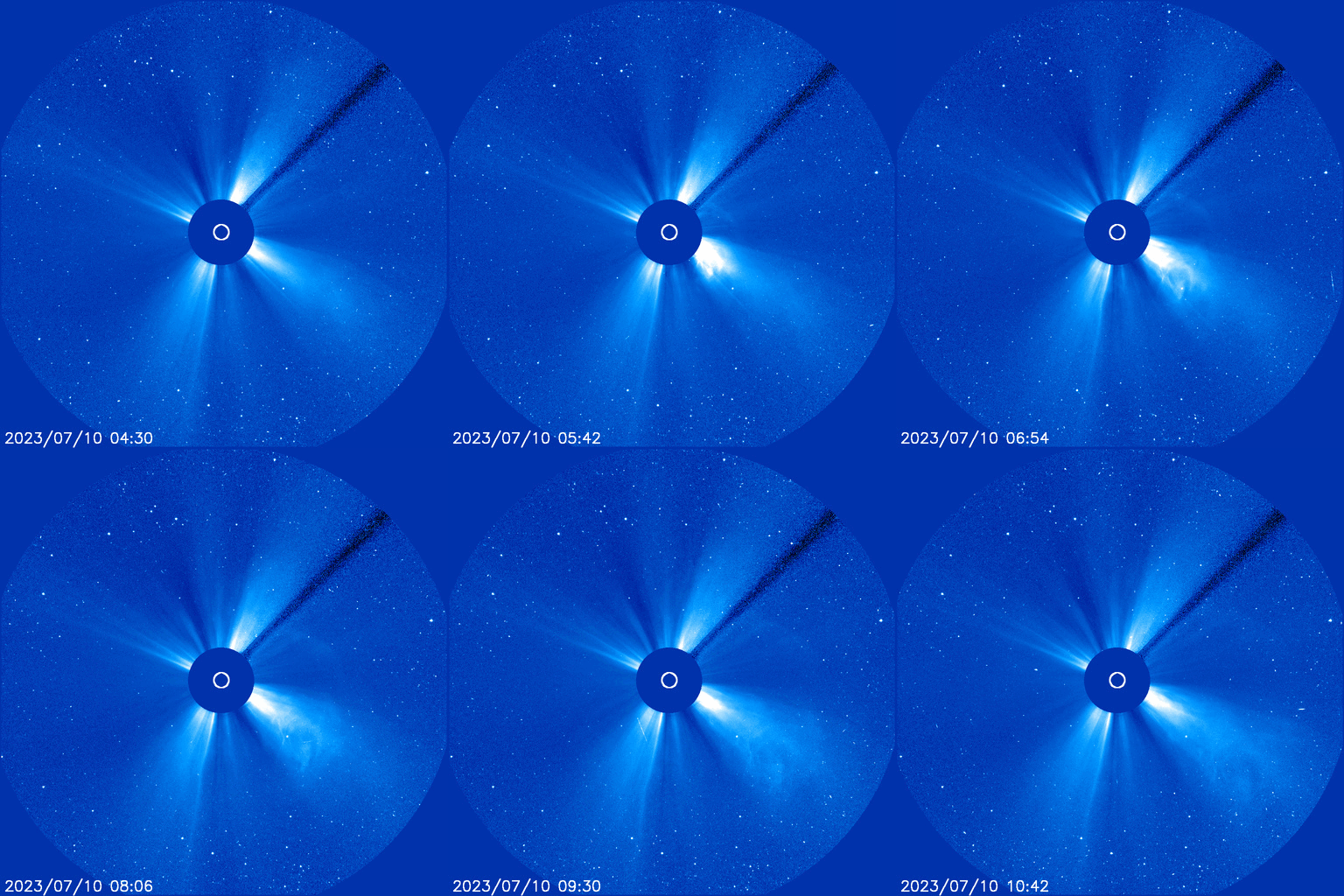
GEOMAGNETIC STORM WATCH: Minor G1-class geomagnetic storms are possible on July 13th when a CME is expected to pass close to Earth. NASA and NOAA models of the CME give different results. NASA predicts a glancing blow, NOAA a clean miss. Either way, a close encounter could disturb Earth’s magnetic field and produce high latitude auroras.

Continue reading

SPACEWEATHER: Noctilucent Clouds, Sunspots, and Solar Flares (July 2023)

Greetings Beloved Kin,

The photographer didn’t identify whether this is Venus or Saturn in the photo of the Noctilucent clouds over Poland. The Full Thunder Supermoon is reflected in today’s weather in Coffeyville, KS and surrounding area. The sky is dark and rumbling with warnings of high winds later this morning. We can use the rain, forecast to change from light to moderate as the winds blow storm clouds this way.

The Sun produced an X-class flare on July 2, 2023. Though not a direct blow toward Earth, it’s likely to produce sky events like the Noctilucent clouds captured in the photo.

SPACEWEATHER NEWS: JULY 5, 2023 

GEOMAGNETIC STORM WATCH: NOAA forecasters say that G1-class geomagnetic storms are possible on July 7th when a partial halo CME is expected to hit Earth’s magnetic field. It was hurled in our direction yesterday by an explosion in the magnetic canopy of sunspot AR3359. 

SUNSPOT COUNTS HIT A 21-YEAR HIGH: The sun is partying like it’s 2002. That’s the last time sunspot counts were as high as they are now. The monthly average sunspot number for June 2023 was 163, according to the Royal Observatory of Belgium’s Solar Influences Data Analysis Center. This eclipses every month since Sept. 2002.

Continue reading

SPACEWEATHER: Earth-directed Fireballs, Reported 06/25/2023

Spaceweather: 06/25/20233, Fireballs of Light directed to Earth – On Jun 24, 2023, the network reported 14 fireballs. (14 sporadics)

7 Flint/ETZNAB: Divine Synchronicity between the Tzolk’in count and Haab Count of the “Diving God” (Descending Light of Truth) aligned with Celestials Signs Above

SPACEWEATHER.COM NEWS: 06/25/2023

Every night, a network of NASA all-sky cameras scans the skies above the United States for meteoritic fireballs. Automated software maintained by NASA’s Meteoroid Environment Office calculates their orbits, velocity, penetration depth in Earth’s atmosphere and many other characteristics. Daily results are presented here on Spaceweather.com.

In this diagram (above) of the inner solar system, all of the fireball orbits intersect at a single point–Earth. The orbits are color-coded by velocity, from slow (red) to fast (blue). [Larger image] [movies]

Continue reading

SPACEWEATHER: X-Flare, a Breath from the Sun, 06/20/2023

X-Class Solar Flare, 06/20/2023

The Sun has been relatively quiet for the past few weeks. Yesterday, the Sun shares the Solar Winds from an X-Class Solar Flare to herald the Summer Solstice.

SPACEWEATHER: JUNE 21, 2023

CME TO STRIKE VENUS AND MARS: A CME launched into space by yesterday’s X-flare (described below) may not strike Earth, however, it will hit Venus and Mars, according to a NASA model. The strike on Venus (June 22nd) will probably erode a small amount of the planet’s upper atmosphere, while the strike on Mars (June 25th) could spark auroras visible to MAVEN and other Mars-orbiting satellites.

X-CLASS SOLAR FLARE AND CME: New sunspot AR3341 erupted on June 20th, producing an X1.1-class solar flare (1709 UT). NASA’s Solar Dynamics Observatory captured the extreme ultraviolet flash.

Continue reading